
CBB Review previews SEC basketball heading into the 2024-25 season.
Is the best basketball played across the Southeast? It’s debatable, but certainly an argument exists for an answer in the affirmative. Welcome to the 2024-25 SEC basketball preview.
The conference is near-impossible to decipher heading into the 2024-25 season, because it seems like every team (save for a couple) upgraded over the offseason. In terms of coaching changes, it was a whirlwind. I was driving down I-77 through West Virginia when I was informed that John Calipari was leaving Kentucky for Arkansas. Shock to the system, truly. It’s like the one time I leave the South, the regional collegiate basketball landscape implodes. I may need to stay in South Carolina for a while.
The only reason Calipari could take the Arkansas job is because Eric Musselman hit his five-year limit. (In the 21st century, even excluding coaching international teams, Muss had held 13 jobs with 12 organizations, and has not once recorded six years straight with the same title.) That left a void in Lexington, which was filled by former Wildcat Mark Pope, by way of BYU. But that wasn’t all. Vanderbilt parted ways with fan favorite Jerry Stackhouse, and replaced him with James Madison coach Mark Byington, who was a former assistant at College of Charleston. (Shoutout College of Charleston.)
While only three schools made coaching changes, those changes weren’t lacking in volume. And even though the conference is now up to 16 teams with the additions of Texas and Oklahoma, somehow only two coaches have been at their respective schools since before 2019: Rick Barnes and Bruce Pearl. While both of those dudes are inked through 2028, it’s worth noting that Coach Cal’s 2019 extension was lauded as a “lifetime contract” and he didn’t even make it halfway through.
Last March and April, we saw eight teams from the SEC make the tournament, but five got bounced in the first round. South Carolina, Florida, Mississippi State, and, shocker, both Kentucky and Auburn couldn’t survive their Round of 64 opponents. Shoutout to both Oakland and Yale on their March upsets.
That left Alabama, Texas A&M, and Tennessee remaining to represent the Southeastern Conference. The Aggies fought hard but fell to Houston in the next round, while Tennessee beat Texas and Creighton en route to falling to Purdue in the Elite Eight. Alabama got the furthest, taking down Grand Canyon, North Carolina, and Clemson to get to the Final Four, where they were matched with defending champs UConn. That game, in short, did not go well. But it was the SEC’s first Final Four appearance since prior to the COVID-19 pandemic, which is actually a crazy stat to think about when the WCC, Mountain West, and C-USA all managed that feat in that span.
This might be the most equal group of teams in recent conference history, with each team having clear positives and negatives entering the season. This preview is just one author’s thoughts, not an amalgamation of various media members’ opinions, so the small sample size (1) might produce results not in line with the conference’s preseason poll. Including below are the projected conference standings at the end of the season, complete with All-Conference teams and awards.
SEC basketball projected standings
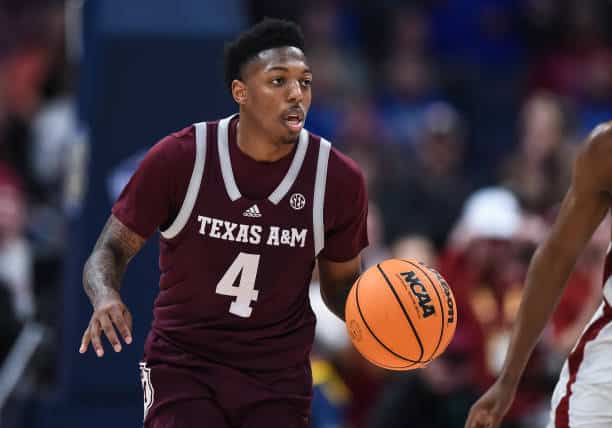
1. Texas A&M Aggies
First things first, I don’t believe that the volume of transfer portal usage by players should be scrutinized to such a degree if those detractors aren’t willing to use that same level of energy to admonish coaches who leave for other jobs in the offseason. It’s literally the same thing. But Texas A&M’s continuity under Buzz Williams is very impressive.
At a certain point, having a roster of entirely transfer portal additions who have never played basketball together (looking at Kentucky) will lead to a lack of chemistry on the court. The Aggies don’t have to worry about that. They return four of five starters, including Wade Taylor IV and Henry Coleman III. And to replace the ever-productive Boots Radford, they plucked Zhuric Phelps out the portal from SMU. Both Manny Obaseki and Solomon Washington showed flashes of legitimately breaking out last season, and Andersson Garcia averaging 9.1 RPG at just 6 feet, 7 inches is actually insane.
Pharrel Payne and C.J. Wilcher also got added to a team that lost just one player averaging over 3.0 PPG (the aforementioned Radford) in the offseason. The team that took a great (but injured) Houston team to the brink in the tournament while not entirely 100% themselves. While other teams spent the summer adjusting to new pieces and learning schemes and playbooks, the Aggies can afford to just run it back, which is beautiful, truly.
The only caveat is the lack of perimeter shooting. As mentioned in the Texas A&M preview, this program hasn’t finished the year with a 3PT% of 33.0% or higher since 2015-16. That’s eight seasons ago. After last season’s clip of 29.3%, they only added one reliable shooter from deep in the portal (Wilcher), which I suppose is the downside of having almost the entire team coming back. Is the hope that the returning players will begin to consistently make their shots from behind the arc?
The names to watch in this aspect? Taylor and Obaseki. Obaseki will more than likely start the season at either the two or three spot, and he led the team with a 40.4 3PT% amongst players with >1.0 attempts per game. In the eight games that Obaseki started, he shot 54.5% from deep and the Aggies went 6-2 with wins over Nebraska, Mississippi State, and Kentucky, to name a few. Oh, and he averaged 16.5 PPG. So please, reader, remember the name. He was a top-40 recruit in the class of 2021, rated just above Jonas Aidoo, Jeremy Sochan, Arthur Kaluma, and Jordan Hawkins. He’s had the potential for a while, but if those eight starts are him finally reaching it, then Texas A&M has a chance to go much further than the past couple years in terms of postseason success.
Taylor shot just 32.5% from deep last year, but did manage a 35.6% clip as a sophomore. If he can find that level of efficiency again, just around 3-4% better, it could drastically improve the team’s fortunes. The Aggies lost four games by one possession last season. Sometimes, one three-ball makes all the difference.
If Obaseki and Washington continue to develop at last season’s pace, we’re no longer talking about the “high floor, low ceiling” Aggies. All of a sudden, the ceiling is as high as these players can raise it.
2. Tennessee Volunteers
Tennessee had some very obvious flaws last year, especially on the offensive side of the ball, where Dalton Knecht would have to play hero in order to eke out wins at times. Knecht, who averaged 9.9 PPG *more* than any other Vol in 2023-24, had eight games of 30+ points, and even then, the Volunteers were 4-4 in those games. Tennessee was 23-5 in all other games.
Defensively, it was another Rick Barnes masterpiece. Tennessee had the 3rd-best defense according to KenPom, behind just Iowa State and Houston. Not only did Josiah-Jordan James, Santiago Vescovi, Jahmai Mashack, and Jonas Aidoo finish the year with a 4.0 or higher defensive box plus/minus (DBPM), but every player with >100 minutes played had a DBPM of over 2.6.
Zeigler (now fully healthy), Jordan Gainey, and Mashack all will reprise their roles, and even with Knecht gone, there’s a new version of him in Knoxville: North Florida transfer Chaz Lanier. Lanier averaged just 4.2 PPG over his first three seasons in Jacksonville, but took off last year, shooting 44.0% from deep and averaging 19.7 PPG. Now he’s in Tennessee. Sound familiar? Maybe like a certain mid-major transfer coming into Tennessee before last season?
He’s obviously not the same player as Dalton Knecht, but they’re similar. Lanier is 6 feet, 5 inches, Knecht was 6 feet 6 inches. Lanier is listed at 207 pounds, Knecht was 213. It’s near impossible to fill the shoes of the now-Laker, but Lanier might be the best bet to at least get close to the same size. And what if Zakai Zeigler, after struggling a bit during the 2023-24 season following a scary knee injury the year before, is back to his old self? The one that led the SEC in defensive rating and averaged 2.0 SPG? Y’all, this could stealthily be a very good team. It feels weird to say that about a squad that’s been quite good for a while now, but I haven’t even mentioned Darlinstone Dubar (Hofstra), Felix Okpara (Ohio State), Igor Miličić Jr. (Charlotte) or top-100 freshman Bishop Boswell yet.
This team wasn’t particularly adept at fixing their weaknesses over the course of last season, but they still won the SEC outright and made the Elite Eight. They lose Knecht, but they gain Lanier and a completely healthy Zeigler this time around. In terms of floor, this team might be highest, but I’ll keep the Aggies above for now just because of the continuity of Texas A&M’s starting five.
3. Auburn Tigers
It feels like last year was Auburn’s best chance to return to the Final Four after making it oh-so-close to the championship in 2019. As a 4 seed, they were a trendy championship pick due to their underlying metrics. But they overlooked Yale, and in a game filled with self-inflicted mistakes, the Tigers fell. Chad Baker-Mazara lost his cool and got kicked out of the game. Aden Holloway went scoreless. And Yale got to shoot 31 free throws because Auburn committed 25 fouls, the fourth time they hit the 25+ mark in the season.
The good news is that the Tigers are returning three of five players with 10+ starts in conference games, with Johni Broome, Denver Jones, and Chris Moore coming back. Broome is the biggest name, obviously, but don’t sleep on Baker-Mazara and fan favorite Dylan Cardwell.
The biggest question, seemingly for the last couple years, has been if Auburn can stop beating themselves. For the past three years, since 2021-22, Auburn has ranked in the top-50 of D-1 in terms of opponent FTA per game. It’s one of those stats where it’s not good to be good at. Last year, out of the 68 tournament teams, Auburn was 2nd in amount of opponent free throw attempts per game, with 24.1 per game. That’s also the reason why they couldn’t make it to the second round. (Funnily enough, Alabama was the only tournament team with more, and the Crimson Tide made it to the Final Four. Basketball is a fickle sport. But rejoice, Auburn fans, you’re above the Crimson Tide for now.)
Holloway, Tre Donaldson, and K.D. Johnson are all gone, but the loss that hurts the most is Jaylin Williams. Mr. Reliable was 2nd on the team in eFG%, win shares, and points produced, and third in box plus/minus and PER. Auburn was 10-0 when he shot 70.0% from the field or better, and 17-8 in all other games. While Pearl brought in two very good players, Miles Kelly and JP Pegues, in the portal, both are guards, as is high-ranking freshman Tahaad Pettiford. Maybe Jahki Howard (247Sports #61 ranked recruit) fills some of that void, but he’s still got a long way to go to match the frame of Williams, and he projects more as a tall SF.
I question the decision to focus mostly on guards (I like Ja’Heim Hudson but he’s not close to Williams’s level) in the portal when the biggest loss on the team was a big forward like Jaylin Williams. And between Baker-Mazara, Jones, Kelly, Pegues, Pettiford, Howard, and incumbent Chris Moore, who’s taking all the minutes in the backcourt/wings? There may be too many mouths to feed to keep everybody happy. On the bright side, I suppose that’s not the worst problem in the world to have, but if Auburn didn’t do enough to replace Williams’s void in the offseason, their ceiling might not be as high as last year. With Broome, however, they’re definitely top three material in the SEC.
4. Alabama Crimson Tide
I feel like Nate Oats is doing a case study on if offense alone can win a championship. With a combination of Mark Sears, Aaron Estrada, Rylan Griffen, and Grant Nelson, the Crimson Tide had four players average >11.0 PPG. They were the only SEC school in the top five of KenPom’s end-of-season offensive ratings, but somehow also one of just five SEC schools below 110 in the defensive ratings of those same metrics. As mentioned in the Auburn portion of this article, the Crimson Tide also led the 68 NCAA tournament teams with 24.6 opponent FTA per game over the course of the season. Of the six players with >4.0 fouls/40 minutes, three (Nelson, Mouhamed Dioubate, and Jarin Stevenson) return.
In the 2024-25 preseason KenPom ratings, Alabama’s defense (93.1) is closer to Merrimack (99.8) than it is to top-rated Houston (86.2). It’s still good for 7th in the SEC, which isn’t bad, but also isn’t championship-level. Before I talk about the defense in-depth, I do want to shout out the offense. Sears returns, as does Nelson, two of the four double-digit scorers. Freshman Derrion Reid is quite good on the offensive side of the ball, and Alabama’s recruiting class in 2024 was ranked No. 2 in the country for a reason. Aiden Sherrell, Labaron Philon, and Naasir Cunningham will all provide offensively in some way this season.
Using one of the fastest paces in college basketball as a mantra has actually worked out most of the time for Nate Oats and Co., with an elite offense becoming the norm in Tuscaloosa. They led NCAA D-1 with over 90.0 PPG last season and made the Final Four. The met a buzzsaw in UConn, and most other teams would’ve been outmatched, too. Shoutout to Alabama’s offense.
Now on to the defense. With the exception of Omoruyi, who is phenomenal defensively, the other three transfers (Chris Youngblood, Houston Mallette, and Aden Holloway) are much more talented on the offensive side of the ball compared to defensively. Only three SEC schools had a defensive rating (non-adjusted) over 109.0 last season. (Like golf, higher is bad.) Two of those schools had less than 10 wins. The other was Alabama.
While the Crimson Tide led the SEC with 90.1 PPG, they finished last defensively, giving up 81.2 PPG on the other end, the only school in the conference to hit the 80-mark. Does the offensive pace negatively impact the defense? In terms of recent basketball history, only one of the past ten champions have ranked within the top 40 teams in terms of tempo. Only two (2017 UNC and 2022 Kansas) have even been within the top 100 in tempo. Alternatively, four of those ten champions were in the *bottom 100* of D-1 in tempo. If I didn’t know any better, (and maybe I don’t) I’d say the tempo is actually counter-intuitive to postseason success. “But George, they just made the Final Four.” Yes. I think that with this style of play, that is Alabama’s ceiling. If they slow it down, they have a chance at a title.
It hasn’t always been the defense that struggles for the Tide. Since 2020-21, it’s gone back in forth from elite to average. Here are the end-of-season KenPom defensive ranks for Alabama over the past four seasons:
2020-21: 3rd of 357 D-1 programs, 1st in SEC
2021-22: 92nd of 358 D-1 programs, 11th in SEC
2022-23: 3rd of 363 D-1 programs, 2nd in SEC
2023-24: 111th of 362 D-1 programs, 10th in SEC
It’s like Nate Oats’s defenses cycle through straight from elite Power 5 to below-average Power 5 every year. According to the trend, sure, they’re due to place 3rd in adjusted defensive rating again. But according to the roster, it seems more like a mid-tier SEC defense again. And an elite offense with a mid-tier defense means Alabama is No. 4 in these preseason rankings.
5. Texas Longhorns
It’s Texas’s first year in the SEC, but they’re already one of the better teams in the conference. Coach Rodney Terry has brought in quite the squad prior to the 2024-25 season. Losing the double-threat of Max Abmas and Dylan Disu stings, but this team almost made the Sweet Sixteen despite those two going a combined 17-61 (27.9%) from the field in the two tournament games.
Abmas, Disu, Tyrese Hunter, and Dillon Mitchell are all gone, but Terry has simply reloaded. In comes Tre Johnson to the wing, the highest rated SEC freshman in the conference. In comes Jordan Pope and Tramon Mark to the backcourt, who averaged a combined 33.8 PPG for two Power Six teams. Freshman Nic Codie could make a difference. The Indiana State duo of Julian Larry and Jayson Kent were phenomenal grabs, and they’ll likely be first off the bench for the Longhorns. And don’t forget Arthur Kaluma from Kansas State.
I haven’t even mentioned returnees Kadin Shedrick and Chendall Weaver. This is a deep roster. Tramon Mark might be the most underrated player in the SEC. And, knock on wood, this seems like a team that fits well together. It’s one thing to get a team with great pieces and no chemistry, but a team with pretty good pieces and solid chemistry will win that game eight times out of ten.
Where did Texas struggle last year? Getting to the line. When Texas was able to get 22+ attempts from the free throw line, they were 7-1. But when they earned 16 or less free throws, the team was 6-8. In a vacuum, that sounds simple. “Texas gets less opportunities to score, they score less, they lose.” But on average, Texas attempted 1.8 FTA per game less than their opponents, while committing 1.0 more fouls per game. It’s a small stat but pretty crucial, especially considering Texas lost eight games by single digits last year.
I’m not completely sold on Arthur Kaluma, either. I believe he has reached his ceiling as a prospect, and I believe the same about Kadin Shedrick as well. But they’re still above-average players, and they can be quite good in their roles. The combo of Tramon Mark and Tre Johnson will be electric. Please watch them, SEC fans. I know y’all haven’t seen much of Texas basketball, but they’re now in the conference and also very good. It’s a plus, and we get to claim Matthew McConaughey now.
6. Florida Gators
Florida has some really fun storylines this season. For example, a 7 feet, 9 inches Canadian walk-on by the name of Olivier Rioux is on the roster. They return Walter Clayton Jr., who averaged 17.6 PPG last year after jumping up from the MAAC and still improving his production. Alijah Martin, one of the stars of the Florida Atlantic Final Four run, is now in Gainesville. One of their incoming freshmen, Urban Klavzar, is from Slovenia. Another, Viktor Mikić, is from Serbia. On the team website, Mikić was asked who he would have dinner with if he had three choices. The answers? Kobe Bryant, Fidel Castro, and Diego Maradona. In all, the Gators represent seven different countries across their roster.
The Gators were good-but-not-great last year, finishing with a 24-12 record. Much like Alabama, they played at a high pace. KenPom put Florida at 23rd in pace nationally. It helped the offense, with a 85.6 PPG mark ranking third in the conference. But like Alabama, the defense suffered, giving up 79.2 PPG, 4th-worst in the SEC. While the Gators got to the line a lot (25.1 FTA per game), they weren’t all too good at making those shots, connecting from the stripe at just a 71.5% clip.
Though the Gators lose two double digits scorers (Zyon Pullin and Tyrese Samuel), they also return two, the aformentioned Clayton Jr. and one-time Belmont Bruin Will Richard, who is entering his third season in Gainesville. Part-time rebounder and full-time Aussie Alex Condon is back as well.
Unfortunately, big man Micah Handlogten is likely out for the year after suffering a broken leg in last March’s conference title game against Auburn.
In his stead, coach Todd Golden grabbed Washington State transfer Rueben Chinyelu, who led the Cougars in rebounding percentage and rebounds/40 minutes. He should make an impact immediately for the Gators. Ultimately, this team seems very similar to last year’s. Florida will likely place close to the top of the SEC in rebounding and pace, but might not be the best defensively overall, even with quality numbers in terms of interior defense.
With this team losing Pullin, Samuel, Riley Kugel (who still was a net positive even if he didn’t reach expectations), and Handlogten, the offensive identity might not be as strong as last season, at least not initially. This is a tournament team, yes, but not an elite one.
7. LSU Tigers
I may be the only member of the SEC media putting this team in the top half of the conference. But I promise it makes sense. LSU has the recruits: three four-star freshmen and two four-star transfers. They have the returning production: Tyrell Ward, Jalen Reed, and Mike Williams III. And they have the coach: Matt McMahon.
Over the last seven regular season games, the Tigers went 5-2 with wins over Kentucky and South Carolina. Tenacious on the perimeter, the top Tiger in terms of steals/40 minutes returns, with Mike Williams (2.6) coming back to the team for his sophomore season. The Baltimore native (not the only one we’ll discuss with this team) finished the year with 13 games of multiple steals, including six against North Florida.
He’ll probably come off the bench, however, with UT-Martin transfer Jordan Sears joining the fold. Coveted by other SEC programs, Sears decided to come to Baton Rouge, where he’ll be joined by Kansas State transfer Cam Carter (14.6 PPG) in the backcourt. Tyrell Ward (the other Baltimore native) is due for a breakout season after a phenomenal end of last year.
In conference games, Ward had a win shares/40 minutes mark of .129. The next closest Tiger, Hunter Dean (.103), was closer to the 7th-highest Tiger (Will Baker, 0.85) than he was to Ward. Ward’s turnover rate in conference games? Just 7.2%, a mark that would have placed him in the top five in the SEC if extrapolated over the whole season. (That mark also led the team in that span.) While he shot a solid 34.9% from deep in the first 12 games of the 2023-24 season, Ward averaged 44.6% from the perimeter after the calendar year turned to 2024. After scoring 10+ points just once as a freshman, Ward did it 14 times last year.
This has the potential to be a very good team, if all goes well. It’s a deep league, and an injury or two would be devastating. But the potential is there, y’all. You’ve just got to look.
8: South Carolina Gamecocks
Note to the world: do not doubt Lamont Paris. He will out-work you, then out-coach you with a smile and a quarter-zip. There wasn’t a lot of confidence in the Gamecocks nationally or regionally entering the 2023-24 season, but Lamont Paris quarter-zipped the haters and somehow squeezed out 26 wins by selecting the exact right fit for all of his player archetypes.
This year, while B.J. Mack, Meechie Johnson, and Ta’Lon Cooper are gone, Collin Murray-Boyles is a legitimate lottery pick. He’s surrounded by a pretty solid starting four of Jamarii Thomas, Cam Scott, Zachary Davis, and Nick Pringle. The Gamecocks might not have the depth of other SEC squads, but their top eight players (including Jacobi Wright, Myles Stute, and redshirt freshman Arden Conyers) are definitely deserving of attention. Davis especially. He’s always been an elite defender, but had a bit of an offensive renaissance late in last season. If he can average around 10.0 PPG and 2.0 SPG? That’s valuable. Very much so.
Granted this team stays out of foul trouble, and out of injury trouble, South Carolina will be back in the tournament. Why doubt Lamont Paris twice? Especially now that he’s got an NBA prospect starting for the entire year? (Murray-Boyles missed the start of last year with mononucleosis.) Paris is one of the smartest coaches in this conference. South Carolina might not have the NIL or resources as other programs do in the region, but he’s done a phenomenal job with what he’s been given, and Columbia wants him here. This is a top-half team in the SEC.
9: Arkansas Razorbacks
John Calipari is wearing red. That’s just such a weird thing to have to type out. I really do believe in this team, I do. There’s very little seperating teams 5-9 on this list. You could put them in any order and I’d (probably) be fine with it. But this reminds me a lot of last year’s Kentucky team. Hastily put together, but really talented, especially offensively. Say what you want to about Cal as an Xs and Os guy (believe me, I’ll say it) but he’s still the elite recruiter he’s always been, even now that the venue’s changed again.
But besides Davis and Aidoo, I’m not quite sure how ready this team is, which is why I have them at 9. Only four upperclassmen with D-1 experience? I love Boogie Fland, and I included Johnell Davis and Jonas Aidoo on my All-SEC teams. Stacking up against very good, veteran squads like Texas A&M? That’s when I begin to doubt. Sure, this team has talent. That’s usually a given with Cal squads. But I feel as if I turn on my TV to watch Arkansas, I’m just going to see 2022-24 Kentucky teams. It’s not horrible. Just not the best. It’s going to take time to gel. I’m personally not a believer in Trevon Brazile’s ceiling.
But that’s the best part about predictions. I’m allowed to be wrong. No one’s going to predict all 16 slots correctly. It can’t be done. Some teams, naturally, will underperform. Some will over-perform. I can’t decide what Arkansas is going to do, so I’ll hedge my bets.
10. Georgia Bulldogs
Either believe in Mike White or don’t. The choice is yours, but there’s definitely a wrong and right option. There’s also apparently a secret third option, but even I’m not aware of exactly what it is. The pickup of Asa Newell to pair with a starting four of Silas Demary Jr., Tyrin Lawrence, Blue Cain, and Justin Abson is such a solid mix of offense and defense. Just an all-around very good balance.
Yeah, Mike White lost a lot of role players. Ok? What would you like me to say? In comes Newell, Somto Cyril, Savo Drezgic, and Jordyn Kee. Mike White can recruit. And in the portal, a duo from Mount St. Mary’s, Dakota Leffew (who, like Jordan Sears, was offered by multiple SEC schools) and De’Shayne Montgomery. RJ Godfrey should allow for more depth, too. I’ll say it, yeah, this team isn’t all too deep. They have open scholarships.
So what? They’ve got a really talented starting five, and if they don’t commit fouls again (just 16.2 per game last year), Georgia can be a real sleeper in the SEC. Know the name Asa Newell. He will ruin your favorite team’s frontcourt.
11. Mississippi State Bulldogs
This is going to be fun to watch. Josh Hubbard + Kanye Clary? Sign me up. And Riley Kugel got added to the mix? Maybe, for the first time in a while, MSU is going to have a really fun offense. They’ve always been gritty, since Ben Howland was in charge, too. But now they’ve got pieces next to the best guard in Mississippi, Josh Hubbard.
KenPom likes this team. They’re one of just six teams in the top 35 for offensive and defensive efficiency in their preseason ratings. Claudell Harris is another solid pickup. Just like last year, this feels like a team that will sort of slip through the cracks, win some big games seemingly out of nowhere, and still show the defensive grit to eke them into the tournament. I think the SEC sends 11 teams to the tournament this year, I really think that’s a possibility.
12. Missouri Tigers
There’s nowhere to go but up for Missouri this year after an 0-18 conference record last season. By the time their first SEC matchup rolls around against Auburn, they will have gone the entirety of 2024 without a conference win. The last time the Tigers took down an SEC opponent? March 10, 2023, when they beat Tennessee in the quarterfinals of the SEC tournament.
But they’ve come close, I promise. In that span, Dennis Gates’s team has experienced 12 single-digit losses. That’s painful. Even with a solid offensive core of Sean East II, Nick Honor, and Tamar Bates, the Tigers were a bit of a mess. The transfer class (besides Bates) pretty much fell flat, and some recruiting hits turned into misses.
While East II and Honor are gone, Tamar Bates is inevitable. The Indiana transfer sometimes looked like the best offensive threat in the SEC at times. Again, at times. Like, maybe once or twice. But that’s still impressive. Dennis Gates seems to have actually hit this offseason. In comes Annor Boateng, Peyton Marshall, Marcus Allen, T.O. Barrett, and Trent Burns. Now that’s a recruiting class. Let’s not forget the transfer class of Marques Warrick, Mark Mitchell, Jacob Crews, and Tony Perkins. Those are four players that would start at most Power Five institutions. (Also additional shoutout Josh Gray.)
Caleb Grill, Aidan Shaw, and Anthony Robinson II also return, and should provide valuable depth. Will Missouri be near the top of the conference? Probably not. But they’re improved, compared to last year, and hopefully luckier, too.
13. Kentucky Wildcats
Kentucky has some solid pieces on their roster, yes. Absolutely. But I have a hard time trying to put together those pieces to form a complete puzzle. Not a single player returns from last year’s squad, which, for all its faults, was a solid team that managed a 3 seed in the tournament. Now, we enter the 2024-25 season with a team that has never played a minute of regular-season basketball together and an evident lack of star power.
The Instagram has already made some comments about Kentucky’s positioning in this list, so I might as well explain it here. I think Kentucky has good, not great pieces, and it’s going to take time for them to gel. Their underlying predictive metrics, at least on KenPom, don’t really point in a top-of-the-conference direction, and they’re lacking star power, which, like it or not, was something Calipari rarely had a dearth of.
This team’s good, but not great. There’s four to five players on last year’s team that would be the best player on this team, and I stand by that. I’m not really in the mood for debate, but I’ll sit back and gladly be wrong about this team. We just have to let it play out first.
14. Ole Miss Rebels
Imagine Alabama, but the offense isn’t quite as good and the defense is the worst in the conference. Welcome to Oxford. It doesn’t matter how many points a team scores if they’re a complete sieve on the other side of the court. In the preseason KenPom ratings, 14 of 16 SEC teams are rated in the top 75 nationally on defense. Mississippi (rated 96th) is closer to No. 16 Vanderbilt (rated 111th) than they are to the rest of the conference, with South Carolina, Georgia, LSU, Kentucky, and Missouri all ranking between 47th-72nd.
Of the nine players with 100 or more minutes played last year for the Rebels, just five had a defensive box plus/minus of 1.0 or higher. All five are no longer with the program. The four players below 1.0 are all returning. Of the six incoming transfers, just one (Dre Davis) had a defensive box plus/minus above 1.0 last season. That’s ten contributors with just one playing defense at a high-quality level, at least statistically. And four of those transfers were playing iffy defense at the mid-major level. What happens when this team is facing off against Wade Taylor, Johni Broome, or Mark Sears, to name a few?
Last year’s team didn’t make the big dance after a late-season collapse (2-9 in their last 11 games) and finished 141st in adjusted defensive efficiency according to KenPom, 12th in the SEC. There’s no clear path to improvement on that end, and the offense is seemingly better than last year, but not to the degree of compensating for what shapes up to be a very bad defense.
Sure, I understand why some are buying the hype around this team’s offense. Matthew Murrell and Dre Davis are on my All-SEC Third Team for a reason. But a team needs to have a defense in order to be successful in the SEC. Besides Davis, I’m not all sure where the defense is coming from this year, especially while he’s off the court.
15. Oklahoma Sooners
It’s an arms race in the SEC, Oklahoma didn’t keep up this offseason. While losing five of their top six scorers from last year, (keeping Jalon Moore, thankfully) they only brought in two players from the high-major level. Duke Miles, Kobe Elvis, Brycen Goodine, that trio is solid. Good, even. But this group just isn’t on the same level as the rest of the SEC, besides Vanderbilt and Mississippi at least. Is Jeremiah Fears ready for the SEC? He may need to be.
16. Vanderbilt Commodores
Someone has to be last, and, unfortunately for Vandy, it’s the Commodores. Mark Byington has replaced Jerry Stackhouse, and just two players (JQ Roberts and Jordan Williams) stayed. The rest are portal additions, led by Jason Edwards, A.J. Hoggard, and Devin McGlockton. I haven’t watched as much tape on this team as I should have, but it’s always a tough job to follow a let-go coach. Byington is the only one with that burden this offseason.
CBB Review Preseason SEC Basketball Player of the Year
Wade Taylor IV, Texas A&M
Based on last season’s production, there’s probably about four names that I wouldn’t mind putting in this spot. Those four are Taylor IV, Mark Sears, Walter Clayton Jr., and Johni Broome. There are others (Chaz Lanier, Josh Hubbard, Dre Davis, Johnell Davis, Collin Murray-Boyles) and some solid freshmen (Tre Johnson, Asa Newell, Annor Boateng, Derrion Reid, Boogie Fland) that will come in with considerable hype as well, but those four are all players that I wouldn’t immediately respond with “well, what about (insert name)?,”when I hear the selection.
Taylor is entering his fourth season in College Station, and all that’s left for him to accomplish is a run in the NCAA Tournament. He’s been named to the All-SEC First Team two years in a row. This year, barring injury, he’ll make his third straight. Mark Sears would be my choice if I didn’t pick Taylor. But I feel like partially, Sears’s scoring numbers are a bit inflated by the Oats Scheme™️. If Taylor had as many opportunities as Sears, he’d be averaging the same amount of points with more assists.
CBB Review Preseason SEC Basketball Coach of the Year
Matt McMahon, LSU
This selection is based on the fact that, in the last two years, a Coach of the Year winner in the SEC has been selected due to surpassing preseason projections by a wide margin, those coaches being Jerry Stackhouse in 2022-23 and Lamont Paris last year. Unless one of the top teams in the conference goes 18-0 or 17-1, I would assume that Rick Barnes, Bruce Pearl, Nate Oats, and Buzz Williams aren’t getting this piece of hardware.
Earlier this month, the media picked LSU 14th in the conference preseason poll, sandwiched between Missouri and Oklahoma. LSU, based on talent, is much closer to the 7th-9th range than the cellar. And Matt McMahon, based on coaching talent, is not in the cellar range either.
LSU is certainly going to finish above 14th in this league. They won’t win it. But they’re better than 14th. This is better than the same team that went 9-9 in conference games last year. So why are we picking them 14th? Matt McMahon is your 2024-25 SEC Coach of the Year, because of the reasons above.
CBB Review Preseason SEC Basketball Freshman of the Year
Asa Newell, Georgia
First off, big shoutout to Mike White for continuing to recruit at a high level. No matter where he’s been, White has shown the ability to close, this time beating out Bruce Pearl and Nate Oats for Newell’s commitment. Listed at 6 feet, 11 inches, Newell is the biggest basketball recruit in Athens since Anthony Edwards. And y’all know how that one turned out.
From all sources, Asa Newell is a very high-level athlete. He’s almost 7 feet tall but can still jump out the building like he’s got springs. Combine that with Justin Abson in the frontcourt? This might be the best down-low defense in the conference. Other similarly-ranked players (Fland, Pettiford, Knox) might have around the same talent level as Newell. But what they don’t have is the same opportunity. Newell will be getting at least 25 minutes a night. He’s going to be in the starting lineup every night for as long as he’s in Athens. And that, combined with his talent, is going to earn him freshman of the year in the SEC.
CBB Review Preseason SEC Basketball Transfer of the Year
Chaz Lanier, Tennessee
If y’all aren’t on the Chaz Lanier train, please hop on before it’s left the station. The former North Florida Osprey went scorched Earth on the ASUN last season, averaging 19.7 PPG in Jacksonville. He’s got SEC size (6’5″, 207), and is almost certainly going to lead a top-25 program in PPG.
He’s got one of the most accurate PGs in the game (Zakai Zeigler) getting him the ball, and has the outside shooting clip (44.4%) to succeed in this league. This is the same Chaz Lanier that dropped 22 on Florida State, 17 on Iowa, 16 on Georgia, even with the defense’s entire focus on him. Lanier is in the perfect situation, and he’s bound for a spot on one of the All-SEC teams.
CBB Review Preseason SEC Basketball First Team
- G: Wade Taylor IV, Texas A&M
- G: Mark Sears, Alabama
- G: Walter Clayton Jr., Florida
- F: Jonas Aidoo, Arkansas
- F: Johni Broome, Auburn
CBB Review Preseason SEC Basketball Second Team
- G: Josh Hubbard, Mississippi State
- G: Chaz Lanier, Tennessee
- G: Johnell Davis, Arkansas
- G: Tramon Mark, Texas
- F: Collin Murray-Boyles, South Carolina
CBB Review Preseason SEC Basketball Third Team
- G: Zakai Zeigler, Tennessee
- G: Matthew Murrell, Ole Miss
- G: Dre Davis, Mississippi
- F: Tyrell Ward, LSU
- F: Asa Newell, Georgia
CBB Review Preseason SEC Basketball All-Freshmen Team
- G: Boogie Fland, Arkansas
- G: Tre Johnson, Texas
- G: Cam Scott, South Carolina
- F: Asa Newell, Georgia
- F: Derrion Reid, Alabama
[…] Y’all, Mississippi’s defense might be historically bad. I said this in the SEC preview, but imagine Alabama but the offense is just average and the defense is a slice of swiss cheese. […]
[…] pick LSU in the top half of the conference in the SEC preseason poll. (Not the actual one, just the CBB Review SEC preview.) The potential is there, y’all. You’ve just got to […]