
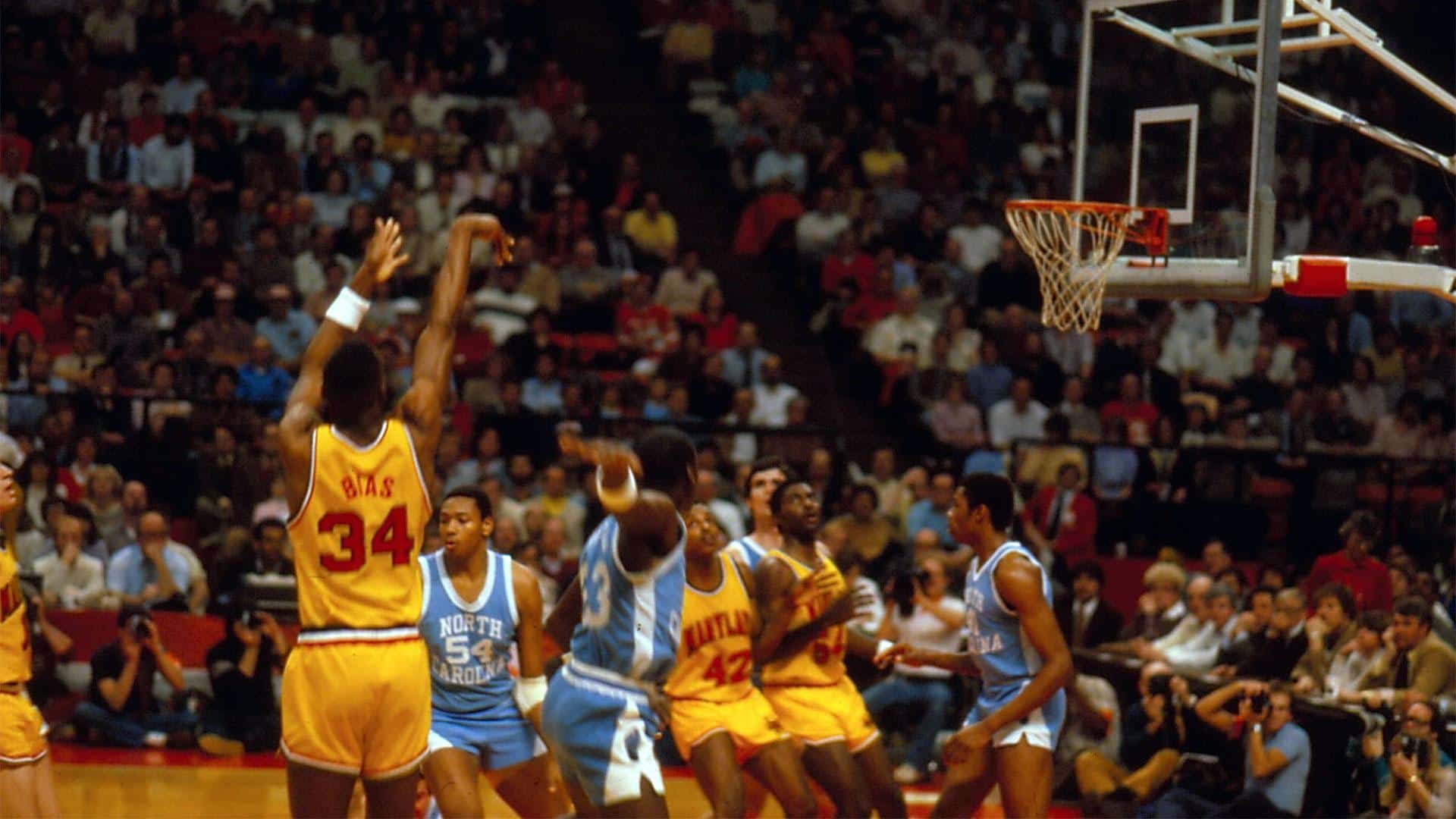
This June will mark the 38th anniversary of Len Bias’s early death, just two days after the star Maryland forward’s name was called second overall to the Boston Celtics in the 1986 NBA draft. In a celebratory early morning party, Bias overdosed on cocaine and collapsed and died on June 19, 1986. He was just 22 years old.
There exists a connotation with the word “poetic” as something beautiful, used to paint pillars in the mind of somewhere or something intricately synthesized as objectively good.
But not every piece of prose is some positive paradise. When we look at the Poe and Plath, those words and stanzas are undeniably poetic despite being directly juxtaposed to the concepts that our brains immediately jump to when we hear that word: hope, aspirations, and storybook endings.
So why do we feel hesitant to label tragedy as poetic? The narrative of a young man with the world in front of him, All-American accolades behind him, and a future of Larry Bird playing beside him, cut down in between dreams. That’s, objectively, material for a poem. A poem that hurts to write and stings to read. A “what could have been” that still hits just as hard today as it did in the summer of 1986, because this irreversible incident is simultaneously unique but tragically relatable to millions of Americans.
There are poems that shouldn’t have to be written, but need to be. Maybe he would have been the next MJ. Then again, he might have been the next Sam Bowie. But that doesn’t actually matter. What matters is that he was the first, and only, Len. This is the second installment in the 1986 series: “Frosty: Lenny’s Legacy.”
I: Frosty’s Beginnings
It’s only about 20 minutes to College Park from Landover, Maryland, where Len, known as “Frosty” to friends and family, grew up. Bias didn’t start getting into basketball until middle school, and at that point, this kid was skinny as a rail. But he caught up real quick. Playing for Northwestern High School in neighboring Hyattsville, the 6’8” power forward blossomed into a star on the hardwood.
College coaches began to take notice, and among them was the head man for the hometown ‘Terps, Lefty Driesell, who had accomplished more in College Park in 13 years than any other coach in Maryland’s history, leading them to the tournament four times. A young Italian by the name of Jim Valvano coveted Bias, too, wanting him to make the drive down to Raleigh for college to play for the Wolfpack. Ultimately, however, suiting up for Maryland was an offer Len couldn’t turn down, and he joined the Terrapins ahead of the 1982-83 season.
Bias’s star turn wasn’t immediate. As a freshman, he had to battle for his role behind future NBAers Adrian Branch and Ben Coleman. That duo combined for 33.8 PPG and led Maryland to the second round of the tournament before they lost to the eventual runner-up, Houston’s best Phi Slama Jama squad, featuring Hakeem Olajuwon, Clyde Drexler, Michael Young, and Larry Micheaux. By the end of the season, however, Bias had already started to develop exponentially on and off the court, bursting into the starting rotation as the year went on.
While the Branch-Coleman duo returned to reprise their roles in the 1983-84 season, it was time for Len to emerge as a legitimate all-level scorer. Two turned to three as Bias joined Branch and Coleman as a trio of go-to scorers in College Park. That triple threat burned through almost the entire ACC, save for Michael Jordan’s UNC squad that included five other future NBA players.
Entering the conference tournament, the ‘Terps were one of just two teams with a winning conference record. (The other, of course, was UNC.) Three games later, one of those two teams celebrated beating the rival Blue Devils and Johnny Dawkins in the final at the Greensboro Coliseum. Spoiler alert: it wasn’t the Tar Heels.
Defeating NC State, Wake Forest, and Duke in three straight days, Bias and the Terrapins cut down the nets for Lefty Driesell’s first ACC conference tournament title, with Len winning the tournament MVP. But the year wasn’t over. Bias and Maryland blew by West Virginia in the first round of the NCAA tournament, putting up 102 on the Mountaineers. Bias put up 18 points on just nine shots. Though he scored 16 in the next round against Illinois and Bruce Douglas at Rupp Arena, the Terrapins fell by two points.
But by the year’s end, just his second with the program, it was clear to anyone lucky enough to catch a glimpse of Maryland that Len’s game was different. He could fly in and jump over a couple defenders en route to an easy dunk, with the reverse being his favorite, just a quick turn and slam.
But his jump shot was a thing of beauty, regardless of position. Plug the lane on defense? Len will shoot over it. Focus on the perimeter? Len will put your best big man on a poster. This was the year that the world was really introduced to Len Bias, the basketball player. Even when going up against future NBA all-stars, the star of the show almost always was Frosty, the kid from Landover.
The next year was, undoubtedly, led by the Bias-Branch duo in College Park, with future Laker Adrian Branch still in town for his senior season in 1984-85. Though they couldn’t retain their ACC tournament title in Bias’s junior year, (Bobby Cremins and Georgia Tech, who somehow beat Maryland three times in the regular season, took home the crown) the ‘Terps made their second straight Sweet Sixteen, taking down Miami-Ohio and Navy (with a sophomore David Robinson) in the tournament before bowing out to the eventual champs, Villanova.
Len continued his star leap as a junior, leading the team in points (18.9 per game), rebounds (6.8 per game), and field goal percentage (52.8%). A true iron man on the court, he played the most minutes out of any D-1 basketball player that year. Bias was named the 1984-85 ACC Player of the Year and a consensus second-team All-American. But by no means was the college career of Len Bias over. If there was a supposed peak of his on-court abilities, rest assured that he wasn’t close to hitting it yet.
Maryland didn’t have quite the same supporting cast that Bias enjoyed the first few years of his career, with just one player other than Len averaging in double-figures, senior guard Keith Gatlin. But that was no problem for the leader of the ‘Terps. Bias ended up pacing the team in points, rebounds, and free throw percentage, along with topping the ACC in points per game with an average of 23.2 per contest, being honored as the ACC Player of the Year for the second straight season, and being named a consensus All-American again, this time on the first team.
Though Maryland couldn’t make it back to the Sweet Sixteen for the third straight year, losing to UNLV in the second round, it was through no fault of Bias. In his last college basketball game, his last basketball game ever, he put up a 31-point, 12-rebound double-double against Jerry Tarkanian’s Rebels. It just wasn’t enough, with the Terrapins falling 64-70.
II: Frosty’s Draft Day and the Future of a Dynasty
If there was a silver lining to the loss, it was the fact that by that point, Len Bias was seen as, by some circles, the best prospect in the upcoming 1986 NBA draft. He was able to score from every part of the court with a sugar-sweet jumper, play at an energy that hardly anyone else could match, jump to a level that no one could reach, and rebound with the best pros in the association.
The Cleveland Cavaliers, fresh off of firing George Karl and replacing him with Lenny Wilkens, ended up with the first pick in the draft following a series of trades, while the defending champions Boston Celtics, fresh off a 67-15 record and arguably in the midst of a dynasty with two titles in three years, lucked into the second overall pick following a trade with Seattle. The Golden State Warriors earned their way to the third overall pick the hard way, finishing last in the Pacific Division with a 30-52 record. There was no way Len would fall below that. On June 17, he’d know if he was going to have to move to Cleveland, Boston, or Oakland.
Making the trip up to New York City with his father for the draft, this was the night that Bias would reap the benefits of all the hard work he had put in for years in his home state. After the Cavaliers went with Bias’s rival from North Carolina, Brad Daugherty, David Stern walked up to the podium to announce the Celtics’ pick. Lenny would have to wait no longer, with the best team in the NBA, Boston, selecting the player that executive Red Auerbach believed was the best player in the class.
Just minutes after getting to the stage, Bias had time for a quick interview with Rick Barry, with the newest member of the Celtics answering a couple questions before the Hall of Famer ended it with a quote that, looking at it today, makes the heart sink: “You said you wanted to play basketball, model clothes, and do some interior designing, you’re going to have plenty of time to do that and probably plenty of money.”
III: Frosty’s Fall
In reality, Len had less than 48 hours. He went out to party in the city, as virtually every draftee has done on draft night since its inception. The following day, he and his father had a meeting with Reebok about a shoe deal before heading home to celebrate with the rest of his family. That night, after spending some time with his family, Bias made his way to campus to keep the celebrations rolling, this time with his friends from the team and college. Over the next several hours, in the early shades of the morning, Len and a few of his friends used cocaine recreationally in the university dorms.
Just after the sun started to rise, around 6 a.m., and with the festivities still raging, Bias collapsed and began to have a seizure. All at once, the room turned frantic. “Let’s celebrate what Lenny’s done,” turned to “what just happened to Lenny?,” in seconds. Brian Tribble, Bias’s friend, called 911, and paramedics came to the university and took Len to Leland Memorial Hospital, where he was hooked up to a respirator. Those with him at the college got to the hospital, then his parents arrived, as did Coach Driesell. But at 8:55 a.m., Len Bias was pronounced dead. The Maryland star and highly touted Celtic rookie was just 22 years old.
The reaction, from the Maryland community up to Boston, back down south and stretching across to the Pacific, was immediate. Len? Len Bias, dead? No, that can’t possibly be true. Millions of Americans waking up to the news that this kid, the superstar forward from the Terrapins that had been picked by Boston just over a day ago, had died? That’s Len, that’s Lenny, that’s Frosty. That’s that dude that sold out all the arenas on the Atlantic coast. We just saw him up in New York, donning that green cap. No way.
After an hour or two, three, maybe four, it began to sink in. Lenny was gone. All across the country, the mourning process began, but especially in the Mid-Atlantic community. Len didn’t just represent the team, he represented the college, the students, the town. Len Bias represented Maryland. The morning he was taken, so was a part of the state. Red Auerbach and Jesse Jackson spoke at his memorial and over 10,000 people showed up to pay their respects.
IV: Frosty’s Legacy and The Juxtaposition of Life and Death
And that, that was it. That was the life of Len Bias. But there’s a second life out there that’s been built over the past several decades, a life born from the minds of people that knew him, people that watched him play basketball, people born after Len’s passing that grew up hearing about him, and now, kids of kids that grew up hearing about Len. That second life is one where Len didn’t collapse in a dorm room two days after the draft. A life where Len Bias led the Celtics’ dynasty to another few championships while catching alley-oops from Larry Bird and Dennis Johnson. One where this tragedy never actually occurred.
But back in reality, the hypotheticals, the “how good could Len have been?,” or the “what would have happened to the Bulls’ dynasty if Len was there to stop it?,” those questions have tried and failed to become answered by journalists, fans, and content creators. At this point in technology’s grasp on reality, anyone can go onto the latest edition of NBA 2K, download rosters with Len Bias on them, and then play out his whole career in a matter of minutes. That’s something that Lenny didn’t get to do, will never get to do. So why should we be given the privilege of doing that for him?
There will never be an answer to any of these hypotheticals, because Len Bias is never coming back. The late 80s and early 90s era of the NBA has come and gone, without Len Bias. It’s happened. It’s over. We can’t change a thing, as much as we would love to somehow go back in time and convince Len to stay home that night, we can’t. It’s impossible. It’s been impossible since he was stretched out on the hospital bed at Leland. And yeah, that hurts. It will never stop hurting. But trying to imagine what could have been just makes the hurt deeper. It’s not fair to those who knew him. It’s not fair to Len.
There will only ever be one Len Bias. A hallmark of the contemporary basketball media landscape is the player comparison. Every year, a few lucky individuals earn the right to be hailed as the next Russ, Bron, or KG. General managers use them to sell their pitch, fans love it, and lunch break discussions are filled with questions over who the true identity is of whoever player their team ends up selecting. Sharpshooting guard, high-flying forward, or rim-protecting center, no matter the player archetype, there will undoubtedly be a name to be found, whether it’s Kobe Bryant or Jaime Echenique.
But there’s one name that, every year, like clockwork, draft analysts and fan bases alike warn about: Len. Don’t be the next Len Bias. I hate that. Sure, I know what they mean, don’t make a fatal mistake days after watching all your biggest dreams come true. But that’s all it was: a mistake. Frosty could destroy rims, but that kid wouldn’t hurt a fly.
Why must we compare players to another? “Len was going to be Mike.” “Len would have been Charles Barkley.” “Len was guaranteed to be Larry Bird’s successor.”. Why not compare superstar prospect Len Bias to high schooler Len Bias? Second overall pick Len Bias to the Len Bias smiling at the camera for picture day in grade school, all dressed up with a red tie? Maryland legend Len Bias to the Len Bias shooting hoops as a kid with his brother, Jay?
Make those types of comparisons, and what would become apparent would be the growth of a young man with nothing but love in his heart. Love for his family, friends, College Park, and of course, the game of basketball.
Death is such a destructive concept. Everything Len worked for on the court, every practice, every game, every time he put on a show on the hardwood, was it all for naught? He was a generational talent, that we know.
But what about off the court? What about the classes Len took, or the lunches with friends? What about every time Len started his day with a glass of orange juice straight from the fridge? Every time Len wore a pair of new shoes? Every time Len took a walk and stopped to pet a dog? Every time Len went into a room, and that voice in his head, the one obsessed with interior design, told him that room could benefit from a different shade of blue paint on the walls?
We’ve established that Len Bias could play basketball. Now, can we please establish that Len Bias was human? Before he was Boston’s messiah turned what-if, he was Frosty. James and Lonise’s baby. Jay’s older brother. The new kid at Columbia Park Elementary.
What’s the point of living life if the only thing people remember is his death? Why is it that when Len’s name pops up, the collective conscience of America immediately turns to June 19? To the news reports, secondary accounts, or the “death” subsection of his Wikipedia page. That one’s just 265 words. In fact, the subsections from “Early life” to “NBA draft” are longer, at 369 words, but to many basketball fans, Len has been reduced to just two words: what if?
V: The Response to Frosty and The Second Tragedy
His tragic death has become the story of his life to people who either don’t know about Len as a person or have only heard stories about him from others. But it is true that his death led to the government issuing a wave of changes for the community that he grew up in, along with communities across the country, all in an effort to prevent a kid in a similar situation from making a similar mistake. Those changes, unfortunately, didn’t help the communities affected. Instead, they suffered.
Chances are, if you’re reading this, you know someone who’s battled through drug issues. It could be a parent, cousin, or friend. If you don’t know anyone that’s struggled with substance abuse, consider yourself lucky. It needs to be pointed out that Len himself wasn’t an addict of any sort, at least according to everyone that knew him. When he was drug tested by NBA teams right before the draft, he came back clean.
All it takes is one time. And that’s one of the reasons why the response to Bias’s death nationally was so strong, the fact that one wrong decision with a substance can just kill a person, just like that, even someone as strong and seemingly invincible as Len.
But Len was by no means the first tragedy. For years before Len, in Washington D.C., New York City, Miami, and cities across the country, kids just like Len were dying from cocaine use. The only difference? These kids weren’t All-Americans. They didn’t star in the best conference in the country then get drafted second overall to the best team in the NBA. Entire communities were tangible, but it took a mountain to fall before the avalanche of concern from the government came along.
That avalanche was felt in College Park, with the “Len Bias Law” getting passed by Congress just over four months after Bias’s untimely death. But instead of helping and educating people in Len’s situation, instead of treating those who developed an addiction to the substance, the proposed solution from the government was to incarcerate them. When the substance crisis reared its head, the government, sports leagues, and other professional industries had a choice: demonize the drug and the people, or demonize the drug and heal the people. Unfortunately for communities across the nation, including College Park, the former was the overwhelming decision.
Three players in the top ten of the 1986 draft, in addition to Bias, struggled with substance abuse. Chris Washburn was picked third, right after Len. He was permanently banned from the NBA in 1989. When Washburn’s playing days were over, he subsisted on food from trash cans and squatting in abandoned homes. William Bedford was picked sixth. He was suspended for the entirety of the 1988-89 season and was out of the league by 1993. Bedford has been arrested three times since.
Roy Tarpley was picked seventh, right after Bedford. He was permanently banned from the NBA in 1995, and sued the league after retirement, claiming violation of the Americans With Disabilities act due to his alcoholism being an illness. The lawsuit was settled in January 2009.
One year later, Roy Tarpley was dead.
For decades, the NBA’s approach to substance abuse was simple: drop the hammer to set an example. Now into the 2020s, can we really say it’s changed? Since 2010, seven players have been suspended for non-PED related violations of the league’s substance abuse policy, serving suspensions ranging anywhere between 10 games (Dion Waiters) to an indefinite suspension (Malik Monk) to a permanent ban (O.J. Mayo). In that same span, Darren Collison was given just an eight-game suspension for domestic battery. Metta Sandiford-Artest (then Metta World Peace, formerly Ron Artest) was given seven games for a blindside elbow to the head of James Harden.
There have been some inroads to progress. In 2021, the league stopped testing for marijuana use in players. But for the most part, the NBA still holds players that are struggling with drug use in the same light as violent offenders. There exists a stigma around players that get suspended for addiction to a substance, a stigma that prevents further success in the league. Of those seven players, three never played in the NBA again following their suspension. Only one (Malik Monk) of those seven is still in the league.
I’m not advocating for drug use. The league is not advocating for drug use. No one is advocating for drug use. But what does need to be advocated for is empathy. The NBA is flush with cash. It is the most lucrative of all American sports leagues when it comes to money being made. Almost every player is a millionaire, and most are multi-millionaires. If one of those players cannot stop using a drug at the risk of losing millions of dollars, then there’s probably an addiction of some sort on hand. An illness. A disease. And yet the association still puts those players on the same level, or lower, compared to violent offenders.
If NBA teams can afford to give out contracts upwards of $40 million per year, they can afford to send a player with an addiction to the best rehab facility the country could offer. They can afford to treat a player with a disease with compassion rather than anger. And we, almost four decades later, can treat Len Bias with compassion, by honoring the person he was, not who he could have become.
VI: The Poetry of Frosty and Lessons from Lenny
There is something poetic about Len Bias. By now, I’m sure you know that I’m not suggesting that there’s any silver linings from his sudden death. It’s an abject tragedy. I’m not suggesting that there was any sort of happy ending at the closing of his chapter. His brother Jay, at just 20 years old, was shot and killed in 1990, just four years later. He’s now buried next to Len. There’s no way to turn back the clock.
But what I am suggesting is that we take a look at who Len was as a person and not what he could have become in the NBA. Because what Frosty had already become before that fateful night; a legend on the court and the sweetest kid off of it, that’s poetic. And that will always be enough.