
The 2023-24 college basketball season is ramping up with the non-conference slate largely over and conference games underway.
Parity is one way to put it – there are a handful of teams that are true contenders to win the National Championship and many more with NCAA Tournament resumes. Some of these teams could use a boost from players not playing totally up to standards.
1. AJ Hoggard, Michigan State
I think it’s safe to say that both Michigan State and AJ Hoggard have been two of the biggest disappointments this season. After a breakout year last year, Hoggard figured to be in for a special senior year. It’s been anything but that. Hoggard’s numbers have retracted in PPG, APG, RPG, and 3P%. Hoggard’s scoring efforts have improved since a terrible first three games of the season. But I’m willing to bet Tom Izzo wants to see more of what Hoggard was able to do in the last two games. His 12-point, 10-assist game against Stony Brook and season-high 17 points versus Indiana State is more like it. That’s the AJ Hoggard everyone wants to see. He’s been playing much better over the last month, and Spartans fans hope it stays that way.
2. Coleman Hawkins, Illinois
There may not be more pressure on any team in America than Illinois. With Terrence Shannon Jr. suspended because of rape charges, the 9th-ranked team in the country needs to find a way to replace his team-leading 21.7 PPG. Marcus Domask is the popular answer, but I’m going with Coleman Hawkins. When it gets down to it, Domask is already doing so much more than asked, as the team’s second-leading scorer before the Shannon suspension. The Southern Illinois transfer has been excellent. I think it’s time for Hawkins, a four-year Illinois veteran, to take his game to the next level. The potential has always been there. Hawkins has just played in the shadow of some great talent. Now it’s the senior’s turn to lead and put this team on his back.
3. Steven Ashworth, Creighton
Steven Ashworth could quite literally be the missing piece between Creighton being a first or exit round exit and a Final Four team. The Utah State transfer has played and shot underwhelmingly, averaging 50% fewer PPG than last season with the Aggies. The move to the Big East was a (slight) upgrade from the underrated Mountain West, but Ashworth’s struggles have been more than just better competition. His three-point shot has suffered and his passes haven’t been leading to as many buckets, despite Ashworth being one of three primary playmakers. Of course, on a team with Ryan Kalkbrenner and Trey Alexander, there won’t be enough shots for everyone. You could argue that with just 6.6 FGA per game, Ashworth needs more touches. He also needs to find ways to be effective in order to be factored in more to the offense.
4. Connor Essegian, Wisconsin
Returning from a back injury is scary and not easy, so it’s important to be patient with Essegian’s return to the floor. But you still can’t look away from the fact that the freshman star is only averaging 7.5 MPG. To be fair, Chucky Hepburn has been cold from three-point range all season, so Essegian gets a pass. But at some point, the 6-4 guard will need to be effective on a Badgers team that struggles to score at times. College basketball fans should be rooting for Essegian’s health because at full strength, he turns the Badgers into true contenders.
5. Cormac Ryan, North Carolina
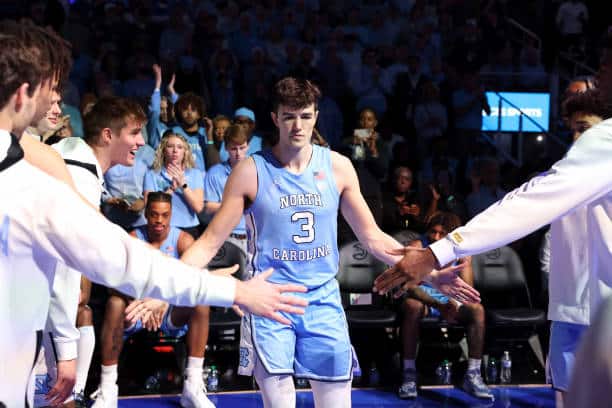
All of the pieces are falling in place for a UNC redemption year. RJ Davis looks like a First-Team All-American, Armando Bacot continues to dominate the paint, and Harrison Ingram has fit in quite well on his new team. Even freshman Elliot Cadeau is looking like a key ingredient in one of college basketball’s main courses. But Cormac Ryan – he’s been a rotten egg. The Notre Dame transfer is only making 28.1% of his threes. This is coming from a guy who hit the 40% mark two years ago and has consistently hovered around at least 35%. Ryan is delivering in other ways – but his shooting could be what Carolina needs to make a deep run in the NCAA Tournament. He’s just 2-of-10 from outside in UNC’s last three games. That needs to change quickly.
6. TJ Bamba, Villanova
A highly sought-after transfer, Bamba’s numbers have dropped from 15.8 PPG to 8.5 RPG. He’s one reason why the Wildcats are one of the worst shooting teams in the country. At 33.3% of the field and from three, Bamba’s inefficiency has been a major problem at times. In Nova’s four losses, he’s only averaging 6.5 PPG and shooting 7-for-34 from the field. But in the last two games, Bamba’s shot well, something for Wildcats fans to hold on to.
7. Santiago Vescovi, Tennessee
What happened to Vescovi? In his fifth year, he’s getting fewer minutes, but not by a big margin. Yet, he’s averaging a career-low 8.0 PPG, to go along with 33.3% from three, and just 2.6 APG. Obviously, this is a deep Tennessee team and when it comes down to it, Vescovi is as experienced as it gets. But it’s odd to see a crucial piece of a top-five team be much less effective in multiple areas of the game. Sure, Tennessee will need to prep for life without Vescovi, but that isn’t what this season is about.
8. Alex Ducas, Saint Mary’s
Much like Vescovi, a drop in production from Ducas has come out of nowhere. But unlike Vescovi, it’s arguably hurt the Gaels. Saint Mary’s was considered a threat to even win the WCC but at 9-6, even with a struggling Gonzaga team, they’re an afterthought. Ducas has played over 130 career games in college basketball, so I’m sure he’ll figure whatever it is out soon.
9. DJ Wagner, Kentucky
John Calipari has gotten the most out of his talented freshman class but DJ Wagner has had the most struggles. Wagner had 22 against St. Joe’s and 28 against Marshall in back-to-back games. Since then, he’s scored under 10 points in three of five games and is shooting just 18-of-38 from the field. Albeit not terrible numbers, we know what Wagner can deliver, based on multiple 20-point outings. And at Kentucky, everyone is under a microscope, so what might not actually be awful numbers will always have room for improvement. And on this year’s team, that could lead to a championship.
10. Alijah Martin, FAU
The third-leading scorer for the 17th-ranked Owls, Martin’s numbers have dipped from last year. He’s averaging 13.0 PPG compared to 13.4 in 2022-23 and 13.9 the year before. And this season, Martin’s FG% is leaving a lot to be desired, connecting on just 38.6% of his shots. A more challenging non-conference slate could be the reason, but Martin needs to shoot more consistently for FAU to make another run in March.
11. Nicolas Timberlake, Kansas
It’s worth mentioning that maybe Timberlake’s role just won’t be as big as initially thought. But a player who averaged over 17 PPG at Towson and now just about 4 PPG at Kansas is worth a discussion. I don’t think Timberlake needs to be a scorer like he was at his past school for KU to be successful. But shooting 32.1% from the field and 27.0% from three won’t make the case for Timberlake to deserve more minutes. His assist rate is also down from last year. If Timberlake can improve, it just gives another reason why Kansas can win its second chip in three years.
12. Caleb Mills, Memphis
The health of Mills is the top concern at this point, as the Memphis guard left their last game against Austin Peay with a hip injury. But Mills’ inconsistencies also need to be addressed. The FSU transfer has had some bright moments, including 17 points against VCU and 13 against Texas A&M. He’s also failed to even reach 10 points in six games and is shooting 38.6% from the floor, his worst mark since his freshman year. It’s not just the scoring struggles either. Mills is only averaging 0.8 steals per game, after averaging at least 1.3 SPG in each of his last three seasons. A scenery change and a deep Memphis roster could be to blame, but a more effective Mills could make Memphis a legitimate second-weekend team in March.
13. Andrew Rohde, Virginia
Sure, Reece Beekman’s 3P% might be a bigger cause for concern, but UVA’s leading scorer has taken on an incredible lift and done well in almost every other area. Rohde on the other hand, might need to start being more aggressive on offense. His field goal attempts have been sliced in half from last year’s 13.9 at St. Thomas (MN). Fewer shots on a Power 6 team is understandable, but for a UVA offense that’s bad even by their standards, someone needs to take initiative. Rohde’s numbers have dipped drastically. FG%? Down 44.8% to 34.0%. 3P%? 32.0% to 30.2%? And an 81.5% free throw shooter is just 3-of-10 from the line this season. Defensively, Rohde is also averaging 1.1 less SPG in just four fewer minutes of action per game. If UVA wants to be taken seriously, Rohde needs to play better on both ends.
14. Donta Scott, Maryland
Donta Scott came back for another year at Maryland and has largely been a shell of himself. The talented forward has a career-worst FG% (38.8%), a career-low in shot attempts, and has seen his rebounding numbers dip. Mind you, Scott didn’t come back to ride the bench. He, Jahmir Young, and Julian Reese figured to be a talented enough trio to lead the Terrapins to another good finish in the Big Ten. Instead, Scott has failed to hold up his end of the stick, and the Terps are sitting at 9-5 and 1-2 in conference play. Scott, who had 24 points against Miami in a non-conference game last year, has the talent to turn this around, but through 14 games, the fifth-year senior hasn’t shown it.
15. Connor Vanover, Missouri
On one hand, Vanover is playing much fewer minutes, about half of last year. On the other hand, his PPG, RPG, and BPG are down three times as much. Of course, Dennis Gates has a reason for the drop in minutes, but Vanover has to respond to his playing time. Less PT needs to result in better play when he is out there, not less production. And for a bubble team, it’s crucial for Vanover to up his play on both sides of the ball. As a 7-footer, he can cause so much havoc.
16. Ryan Nembhard, Gonzaga
The Creighton transfer has played well overall, but with the Zags being just 9-4, his 15.0% clip from deep is a glaring issue. Luckily for Nembhard, that’s about the only blip in his play. He’s still scoring the ball from other areas and leads the Bulldogs in assists. If he can get those three-point numbers up, expect a Gonzaga turnaround.
17. DJ Rodman, USC
The big man hasn’t played like a big man and for a 7-7 USC team, that’s got to change. Rodman has been wildly inefficient from the field, which shouldn’t be an issue, considering he transferred in conference to a better team. Still, his numbers have dipped, and that includes his rebounding efforts. Calling out the son of Dennis Rodman for a lack of rebounding seems crazy but it’s true. For a team that ranks T-7th out of 10 in rebounding in the conference, the Trojans could really use some more help.
18. Max Rice, Boise State
Time is ticking on Boise State to get hot if they want to make the NCAA Tournament in back-to-back years. The team returned a lot of last year’s production, but Max Rice hasn’t been off to the greatest start. The Broncos’ guard has all the skill in the world but hasn’t found his shot – or his the boards this season. Rice’s shooting numbers have been iffy and he’s down from 4.6 RPG to 2.8 RPG. Boise State has four other solid rebounders so that part doesn’t need to change, but he needs to stay hot. Rice has scored 20 points or more in three out of the last five games, after failing to even score 15 points in seven of their first eight games.
19. Rich Barron, Providence
A name not many college basketball fans know, Barron is an important bench player for the Providence Friars. Of course, the same Friars team that just lost Bryce Hopkins for the season with a torn ACL. Barron, a freshman, has contributed well at times, highlighted by a 14-point outing against Sacred Heart. As a bulky 6-5 forward who can drill the floor, Barron seems like a good fit to chip in with Hopkins out for the remainder of the year. It will be a team effort, but keep an eye on the freshman to deliver.
20. Jamal Mashburn, Jr., New Mexico
The first of a two-part story here, Jamal Mashburn is a lethal scorer, but like many of the players on this list, hasn’t been efficient. After two identical years of 42.8% from the field, Mashburn is down to 34.2%. But even worse, he’s seeing career lows in APG, SPG, and worst RPG since his freshman year. Now, Richard Pitino added talent in the transfer portal, so sometimes it’s a product of that, but having watched multiple New Mexico games this season, the Lobos play sporadically and a lot of times it’s because they follow the lead of their stars.
21. Jaelen House, New Mexico
That bring us to Jaelen House, one of my favorite players to watch. The UNM star will pull from anywhere on the court. If New Mexico gets to play in March Madness, they’re a popular pick to pull off a Cinderella run for a few reasons. Number one being Jamal Mashburn Jr. and number two being Jaelen House. Still, a 34.8 2P% is almost unacceptable. At times, House plays out of control and it limits what New Mexico can accomplish. Once House and Mashburn can find their shots, a 12-2 New Mexico team could still be that much better.
22. Naheem McLeod, Syracuse
The Orange have a plethora of talented scorers, none as gifted as Judah Mintz, who is averaging a touch under 20 PPG. But the five position hasn’t been kind to Syracuse. 7-4 Naheem McLeod has struggled to provide much of anything offensively, and after a promising start on the defensive end, has only blocked seven total shots in his last seven games. Four against Pittsburgh was a good sign, but if McLeod isn’t going to be an important piece of the SU offense, he’s got to be a better rim protector.
23. Jose Perez, Arizona State
The Sun Devils are almost sub-300 in APG and I look to Jose Perez. The transfer, on his fifth team in six years if you count West Virginia, is having a career-low of 2.8 APG if you take out his lone season at Marquette where Perez only played 10 games (11.3 MPG). Perez is entrusted with the ball in his hands often and has been a reason why ASU is one of the worst teams in the country in assists and points. Frankie Collins can’t do it all by himself.
24. Spencer Johnson, BYU
It almost doesn’t even feel fair to be writing this, because BYU has blown away any preseason expectations and Johnson has played just fine. But can you imagine if the 29.3% three-point shooter was hitting 42.2% of his attempts as he had through his first three seasons? There’s a chance that the Cougars, at 12-1 and 2nd in the NET Rankings, might still be far from their true potential.
25. MJ Collins, Virginia Tech
Virginia Tech has been up and down all season long and MJ Collins could be the fix. In two of their four losses, Collins didn’t play, and the Hokies got blown out. In the two losses he did play in, Collins had 2 points and 0 points. The sophomore guard is shooting – believe it or not – 26.5% from the field. A season-long slump hasn’t been kind to the talented guard who could be what the Hokies need in order to reach their full potential.